Monday, February 17, 2025

ALL ON RAMADAAN PREPARATION...


https://i.pinimg.com/originals/98/87/35/988735e75ed21d52f7abd9303e453fc4.jpg
INSHA'ALLAH CLICK TO VIEW/READ ALL NEEDED POSTS:

Practice of Tazkiyah (Self-Purification)


Lexically, the Arabic word `Tazkiyah' means purification and development—of anything—to the level of perfection. As a Quranic term, it expresses a way of ridding ourselves of flawed tendencies and leanings as well as providing one with the means to attain piety and to help our souls develop to become as perfect as humanly possible. In other words, the ultimate goal of Tazkiyah is for man to purify himself and prepare for his return back to his ‘original home’ and “final abode,” Paradise. Allah tells us in the Quraan: "By the soul and the proportion and order given to it; and its enlightenment as to its wrong and its right; truly he succeeds who purifies it and he fails who corrupts it!" [91:7-10]

These verses present a straightforward outline of Islam's notion of Tazkiyah. Allah has so created the soul that it has both inclinations—good and evil—and man has been endowed with the power to distinguish between the two. Therefore, the path of success for man, in this life and the one to come, involves choosing the side of good and striving to make it prevail—not just in the world and his surroundings, but first and as a pre-requisite for societal and environmental reform, within himself.
In this sense, the need for Tazkiyah is part of our innate nature—it is hardwired into our consciousness. Hence, man has always known and attempted to fulfill this innate need by seeking out all ways of contemplation, meditation, and worship. Yet, only the ways provided to him by the Creator, through the various revelations, have worked for him, and these revealed ways of self-reflection and change are the only ways of self-purification that can work for him. Moreover, they have worked only so long as man managed to keep these ways themselves pure and clean—something man has not always had success at doing.

Muslims are not exempt from this failure to keep the means purified. Like others, we have suffered at times from maintaining authentic and unadulterated ways of Tazkiyah. This is true for both Muslims of the past and Muslims today. Many of us have allowed ourselves to modify or deviate from the authentic modes of Tazkiyah delivered to us through revelation—in the Quraan and Sunnah. Part of the reason for this is definitely the increasing strain of outside influences, but this is not its main cause.

The primary source of our inconstancy is a basic and widespread lack of proper understanding of the Quraan and the Sunnah.
This is unfortunate because Allah says: "We have sent you a Messenger, from yourselves (Muhammad), reciting to you Our verses and purifying you (through tazkiyah) and teaching you the Book (Quraan) and wisdom (Sunnah) and teaching you that which you knew not." [2:151], and the Prophet (saws) himself said: "I have left you upon a clear proof." [Ahmad]


Hardship must be Alleviated !!!


https://s-media-cache-ak0.pinimg.com/originals/9a/94/a6/9a94a67e90340d0e2e19e05d24ed0c48.jpg
To understand this maxim, it is necessary to know that the word “hardship” used in it is not the same as “difficulty.” Unlike hardship, difficulty is not necessarily bad; success in life does not come without difficulty and hard work. Moral responsibility (takleef), which is the basis of Islamic religious obligation, literally means in Arabic “imposition of a heavy burden” due to the fact that acts of worship and other religious duties require some degree of difficulty. 

Hardship, as referred to in this maxim, excludes beneficial difficulty like that required for training, study, work, and worship. Islam places high value on purposeful exertion but requires the alleviation of detrimental difficulty. The preceding maxim, “harm must be removed,” emphasizes elimination; harm must be eliminated, not necessarily replaced with something else. The focus of this maxim is different; hardship must not just be eliminated; it must be replaced with something better.

 “Hardship must be alleviated” requires the creation alternatives, because alternatives are the means by which alleviation takes place. In many cases, it may not be desirable to eliminate completely a type of behavior  that  is causing hardship; it may be better to modify that behavior or create alternatives, so that it or something better than it may be done in a manner that is easier and more rewarding. 

The Qur’an states:It is not God’s will to cause you distress; rather, it is God’s will to make you pure.” [5:6]. It says elsewhere: God wills to make things easy for you, for human beings were created weak.” [4:28].

The Etiquettes of Eating

It may appear a little ironic to be discussing the subject of FOOD in a month, which is characterized by the command to abstain from it! Nevertheless, it is true to say that in this month the subject of food tends to receive special attention from us, for after a whole day of keeping our desires and hunger pangs at bay, the chance to eat ones till in the evening is much appreciated. An appropriate time therefore to highlight some of the Islamic etiquettes of eating we think.

For every act that a Muslim does, there is a chance for him to earn some reward for it from Allaah. From praying to per­forming ghusl, in everything Allaah has placed His Blessings and these blessings are multiplied in the month of Ramadaan.

These rewards and blessings can be attained only by those keen to imbibe the Guidance and Example (Sunnah) of the Prophet Muhammad (saws) into every mode of their lives, seeking thereby none but the Face of Allaah. For such people, their whole lives become ‘Ibadaah. Even the act of eating and drinking upon which all living things depend can become acts of
‘Ibadaah. Thus, by acquainting ourselves with the Sunnah of eating and drinking we too can turn this mundane exercise into an act of worship and a source of blessing, Insha’Allaah!!

The Etiquettes of Eating

1] How to Begin [
There is a common misconception that to wash ones hands before eating is from Sunnah. This is based on the hadeeth which alleges that the Prophet (saws) said: "The blessing of the food is in washing the hands before it and after it." [Ahmed, Aboo Dawood and others] It should be known however that this hadeeth is daef (week) according to Aboo Dawood. Infect some scholar went as far As to say that this practice was disliked since it was a practice of the Jews and only if there was a reason to wash them was it not disliked. The point is that washing the hands before the meal contains no added reward since it is not from the Sunnah, although there is no harm in doing as if one needs to]
When a Muslim begins to eat, he should begin with the name of Allaah. As the Prophet Muhammad (saws) said: ‘When one of you eats, he should mention Allah’s name (i.e. say ‘Bismillah); if he forgets to mention Allah’s name at the beginning, he should say (when he remembers): I begin in the name of Allah at the beginning and at the end of it ( Bismillah awwalahu wa Akhirahoo).” [
Saheeh - Narrated by Aaisha and collected by Aboo Dawood. Authenticated by at-Tirmidhee and al-Albanee inhis Saheeh. Sunan Aboo Dawood. Note that the Sunnah is to say ‘Bismillah’ only and not ‘Bismillah Ar-Rahman Ar-Raheem’]
 

Battle of Badr - a battle between Truth and falsehood !!!

References: Tafseer Ibn Katheer, ar-Raheeq al-Makhtoom by Shaikh Safi ar-Rahmaan Mubarakpuri, The History of Islam and others.

Life in Makkah was becoming difficult for the Muslims. The growing oppression and tortures of the Kuffar became unbearable. The Muslims were prevented from worshiping Allah. Consequently, Allah, the Exalted, revealed orders to migrate. The Prophet (saws) and his companions secretly planned to escape the watchful disbelievers, who intended to kill the Prophet and his companions in their own homeland and thus bring an end to the religion of Islam. But Allah, the Exalted, aided His Messenger (saws) to immigrate to al-Medina. This carefully planned and prudent escape of Allah's Messenger (saws) and the Sahabah created great anxiety and rancor in the hearts of the disbelievers.

The new abode of Allah's Messenger (saws), al-Medina, integrated the commercial routes to Makkah. The trade caravans of the disbelievers passing near al-Median now faced serious danger. The disbelievers had already experienced the love and devotion of the Sahabah for Allah and His Messenger (saws). They knew that the Sahabah were always ready to sacrifice everything they had for the Prophet (saws). Thus, in order to safeguard their trade, the disbelievers undertook all possible efforts to expel the Muslims from al-Medina.

They sent a serious ultimatum to the chief of the disbelievers in al-Medina, Abdullah Ibn Ubai Ibn Sahul, ordering him to fight or drive out the Prophet (saws) from al-Medina. Otherwise, they would attack their city and destroy their people. However, the Prophet (saws) cautioned Abdullah and his men from taking any cruel steps against the Muslims and as a result of his cowardice, Abdullah withheld his devilish plan. The disbelievers of Makkah also sent a note to the Ansaar (the Muslims of al-Medina who aided Allah's Messenger (saws)) threatening to put them to death if they helped the Prophet or defended him. But the Ansaar loved Allah's Messenger (saws) more than their lives and therefore paid no heed to the threats.
 

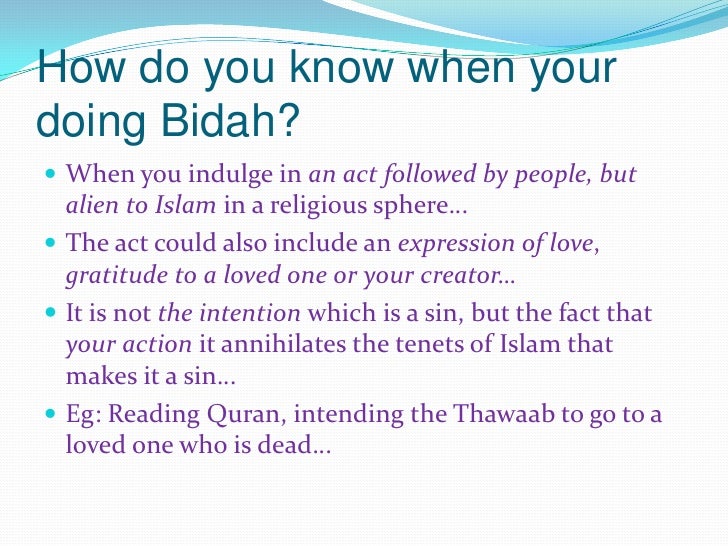
How do we know what is AND what is not a Bidd`ah?

http://image.slidesharecdn.com/mostcoomonbidahinasiansocieties-100922090837-phpapp01/95/most-common-bidah-in-asian-societies-6-728.jpg?cb=1287053779

This is a very important point which when discussed clarifies detailed principles under the light of which an action can be known as to whether it is a bid'ah or not. "This is because Allah, the Blessed and Exalted, will not accept an action until two conditions are fulfilled:

1. That it be done sincerely seeking the Face of Allah.
2. That it be righteous, and it cannot be righteous until it is in conformity to the Sunnah, not in contradiction to it."
['Hujjah an-Nabee' (pg. 100) of our Shaykh al-Albanee. It was upon these two principles that Shaykh al-Islam ibn Taymiyyah based his superb book 'al-Uboodiyyah' on.]

Our Shaykh, al-Albanee, said in his book 'Ahkaam al-Janaa'iz' (pg. 242),
"Indeed the bid'ah which the Sharee'ah has textually stated to be misguidance is (of a number of types):
1. Everything that contradicts the Sunnah, be it in actions, sayings or beliefs even if this arise out of ijtihaad."

I say: as-Suyutee said in 'al-Amr bi al-Ittibaa' (pp. 92-93),
"This differs in accordance to the different circumstances and to the extent in which it contradicts the Sharee'ah. Sometimes this leads to that which would necessitate forbiddance and sometimes it does not exceed the bounds of detestability. It is possible for every skilled legal jurist to differentiate between the two types especially if he has deep-rooted knowledge and faith.
[FN. Rather all innovations in the religion are forbidden].

This category of vile innovation is sub-divided into two:

1. In matters of belief that lead towards misguidance and loss.
The adherents to the deviated sects are of six types, and each type is further divided into 12 sects - this making the 72 sects about which the Prophet (pbuh) informed would be in the Fire. We are not, at this juncture, going to detail them but the one who sticks to the Sunnah and the Jamaa'ah and steers clear of the foundations and offshoots of these innovations will be from the Saved Sect by the Permission of Allah.

2. In the actions and these are further sub-divided into two:

The Different Types of Death

Our beloved Prophet Muhammad (pbuh) and the Salaf constantly reminded themselves, and others, about the point where the rizq (provision) and the ajal (lifespan) would collide, resulting in the termination of all desires. A point where the mahdood (limited life that has a beginning and an end) would finish its journey, and the abbadie (infinite, everlasting life) would begin. All of this being decreed by Allah who is al-Azzalee (eternal, has no beginning and no end). Mawt (death) is something that we need to persistently think and contemplate about all the time.

The linguistic meaning of mawt

Al-Kufr (Disbelief)

إِنَّكَلاتُسْمِعُالْمَوْتَىوَلاتُسْمِعُالصُّمَّالدُّعَاءَإِذَاوَلَّوْامُدْبِرِينَ

Truly thou canst not cause the dead to listen, nor canst thou cause the deaf to hear the call, (especially) when they turn back in retreat. [27:80]


فَإِنَّكَلاتُسْمِعُالْمَوْتَىوَلاتُسْمِعُالصُّمَّالدُّعَاءَإِذَاوَلَّوْامُدْبِرِينَ

So verily thou canst not make the dead to hear, nor canst thou make the deaf to hear the call, when they show their backs and turn away. [30:52]


Al-'Aql (Sanity)


أَوَمَنْكَانَمَيْتًافَأَحْيَيْنَاهُوَجَعَلْنَالَهُنُورًايَمْشِيبِهِفِيالنَّاسِكَمَنْمَثَلُهُفِيالظُّلُمَاتِلَيْسَبِخَارِجٍمِنْهَاكَذَلِكَزُيِّنَلِلْكَافِرِينَمَاكَانُوايَعْمَلُونَ
 

Can he who was dead, to whom We gave life, and a light whereby he can walk amongst men, be like him who is in the depths of darkness, from which he can never come out? Thus to those without faith their own deeds seem pleasing. [6:122]
 
Al-Shiddah (Hardship)
 
يَتَجَرَّعُهُوَلايَكَادُيُسِيغُهُوَيَأْتِيهِالْمَوْتُمِنْكُلِّمَكَانٍوَمَاهُوَبِمَيِّتٍوَمِنْوَرَائِهِعَذَابٌغَلِيظٌ

In gulps will he sip it, but never will he be near swallowing it down his throat: death will come to him from every quarter, yet will he not die: and in front of him will be a chastisement unrelenting. [14:17]

 
Al-Khawf (Fear)

يَتَجَرَّعُهُوَلايَكَادُيُسِيغُهُوَيَأْتِيهِالْمَوْتُمِنْكُلِّمَكَانٍوَمَاهُوَبِمَيِّتٍوَمِنْوَرَائِهِعَذَابٌغَلِيظٌ

In gulps will he sip it, but never will he be near swallowing it down his throat: death will come to him from every quarter, yet will he not die: and in front of him will be a chastisement unrelenting. [14:17]


ALL POSTS ON VALENTINE'S DAY !!!

https://i.pinimg.com/originals/cd/f8/ba/cdf8bafae1f30074986b20b72be967dd.jpg

INSHA'ALLAH CLICK TO VIEW:
As the false and evil pagan festival known as Valentine's Day approaches, we will see the fools and feeble minded racing to purchase gifts and make plans for a special day/night with their spouses as a sign of their love for them. Even many of those who are normally abusive toward their spouses will avail this opportunity to profess their love to their spouses. It's all hogwash, silly, fake and ridiculous. The same applies to so-called wedding and couple's anniversaries.

It is absurd to think that "celebrating" a specific day each year will revive and keep alive the love in a marital relationship. Had there been any good whatsoever in it, we would have been guided to it in our perfect and complete Religion (Islam), and our role model and the best and most perfect of all human beings in every way, Muhammad (saws), would have celebrated and encouraged its celebration. Rather, we have been guided to being kind and treating our spouses well all the time.

Sufficient are these Ayaat !!!


For Educational purpose only and to raise Intellectual and Political awareness!


Question: O virtuous Shaykh of us. What is the best way to answer the one who warns from the consequences of rushing towards Jihad in ‘Iraq and advices (Muslimeen) to wait with that? Then we see who follows this thought and opinion being happy when Baghdad falls (in the hands of the occupiers) saying: “I’m impressed by so an so Shaykh, because they warned from rushing and they advised the youth to be careful and to wait, and if they had listened to them, they would not have been killed and so and so did not happened to them?” Jazakum Allahu khayra. 

Answer: My beloved brother, contemplating on the Ayaat of the Noble Qur’an while comparing it to a lot of the actions of the Muslimeen, or those who claim to be Muslimeen, during the Crusader’s war since it started in Afghanistan till today, he will be amazed by many of the matching descriptions mentioned by Allah about them. 

Firstly: When a lot of Mujahideen brothers where killed in Afghanistan and there occurred a massacre and those who were taken as prisoners were taken to Guantanamo, may Allah hasten their release, one of the Du’aat  came out on of the TV-channels, saying: “If those people have obeyed us, this killing and imprisonment would not have happened to him!” SubhanAllah! Read as an answer to him, the saying of The Most High: "O you who believe! be not like those who disbelieve and say of their brethren when they travel in the earth or engage in fighting: Had they been with us, they would not have died and they would not have been slain; so Allah makes this to be an intense regret in their hearts; and Allah gives life and causes death and Allah sees what you do." [3:156] 

The True meaning of Defeat !!!

https://i.pinimg.com/originals/05/b4/6e/05b46efe3e1d2b672ab0fd3339357fcf.jpg
For Educational purpose only and to raise Intellectual and Political awareness!

If the enemy is killed in the battlefield, he considers that as defeat, but we do not. The conflict in its realities is a conflict of ideas that is translated into battles. If a person gives up these ideas, that is defeat.

The first form of defeat: 


"Never will the jews nor the christians be pleased with you till you follow their way. Say: ‘Verily, the Guidance of Allāh is the (only) Guidance.’ And if you were to follow their desires after what you have received of (revealed) Knowledge, then you would have against Allāh neither any protector nor any helper." [2:120] 
When a Muslim gives up what Allāh has given them, and follows any other way; Whether this following is partial or complete this is the greatest form of defeat. Following their way does not mean you declare it publicly, as this is rare. But the Āyah is referring to those whose actions and words are similar to those people mentioned in the Āyah, then you are following them. The Āyah is talking about adapting their method.
Proof of becoming a kāfir does not necessarily mean one has to declare it. We define Īmān to be; words, belief in the heart and actions. Kufr can be applied to all three of these. If someone’s words, beliefs or actions are that of the kuffār, then they are of them. Ibn Taymiyyah said, “The kuffār are pleased when the Muslimīn follow them, even in things that are classified as appearance.” We find that the kuffār are extremely happy when the Muslimīn don’t wear the hijāb. Even though is a matter of how we should dress. 

Loving and glorifying the Sunnah...


Do you truly love the Messenger of Allah (saws)? A fundamental of our religion, and a tenet of our faith, is to love him.

 Allah says: “Say (O Muhammad): ‘If your fathers, your sons, your brothers, your wives, your relatives, wealth which you have obtained, commerce wherein you fear decline, and dwellings with which you are pleased are more beloved to you than Allah and His Messenger and Jihaad  in His cause, then wait until Allah executes His command. And Allah does not guide the defiantly disobedient people.” [9:24]
Al-Fudhayl ibn ‘Iyaadh said: “This verse is enough of an evidence to prove the obligation of loving the Prophet (saws) because Allah dispraised in it those whose wealth, family or children are dearer to them than the love of Allah and His Messenger (saws) describing them as defiantly disobedient at its conclusion.”

Love of the Prophet (saws) branches from Allah’s love of him; our love of the Prophet (saws) is due to the fact that Allah loves him, and because Allah sent him to us as His Messenger, as well as the fact that Allah instructs us to make him dearer to our hearts than our own souls. He says: “The Prophet is more worthy of the believers than themselves…” [33:6]
This means that the believer should love the Prophet (saws) more than he loves his own self.

This love entails full obedience, submission and acceptance; it also entails favouring the Prophet (saws) over oneself, one’s family and one’s wealth, and to surrender to the Prophet (saws) the controlling direction that one has over himself.

The influence that the Prophet (saws) should have over us is greater than that which a master has over his slave, or a father has over his child. We should have no control over ourselves except in acting in accordance with the way he (saws) directed us to.

It is for every Muslim to prove his love for him, which can be determined according to the following narration of the Prophet (saws): “There are three qualities; whoever has them will taste the sweetness of faith: To love Allah and His Messenger (saws) more than anyone else…" [Al-Bukhari and Muslim]

Al-Khansaa - Poetess and Mother of Martyrs !

https://i.pinimg.com/originals/78/31/3c/78313c282404cc6b30448447cdeda5a4.png

According to the connoisseurs of Arabic poetry, there has never been a woman whose poetry was as replete with knowledge, or who was more knowledgeable  than Al-Khansaa' (ra). The Prophet (saws) used to ask her to recite her poetry, which he admired, in front of him.  She composed a great deal of poetry, and the most eloquent of her poetry were odes in lamentation of her two brothers, Sakhr and Mu‘awiyah, who were killed during the pre-Islamic era.

She spent the greatest part of her lifetime during the pre-Islamic days, and when Islam appeared, she embraced it and went to the Messenger of Allah (saws) as a member of the delegate of her tribe, Banu Sulaym.

She was recognized for her deep faith in Allah and His Messenger (saws) and her zeal for Jihad in the cause of supporting the truth. She attended the Battle of Qadisiyyah in 16 AH, in the company of her four sons. During the first part of the night, she said to them:
"O my sons! You have embraced Islam willingly and emigrated freely. By Allah, other than Whom there is none worthy of worship, you are the sons of one man and one woman. I have never betrayed your father nor have I disgraced your maternal uncle, nor have I dishonored your noble lineage, nor have I tampered with your parentage. You indeed know the abundant reward prepared by Allah for the Muslims. It should be known to you that the everlasting abode is better than the perishable abode. Allah says: "O you who have believed, persevere and endure and remain stationed and fear Allah that you may be successful." [3:200]
Should tomorrow morning come upon you while you are safe, Allah willing, go early to fight your enemy with courage, and seek the support of Allah against His enemies. When the battle becomes fierce, betake yourselves amidst it and be eager to fight bravely when the army is engaged in combat, perchance you receive gain and honor in the abode of eternity.”

The Awakening...


The first of the ranks of the journey of servitude (‘ubudiyah) is awakening, which is alarming and stirring up of the heart from the sleep of heedlessness. By Allah, how priceless is that revitalizing alarm! How valuable and indispensable for the journey! Whoever experiences it, by Allah, he has indeed experienced the breeze of success. Without experiencing it, everyone is lost in heedlessness. His hearing is asleep while his eyes appear awake. It is this blessed alarm that wakes one up and makes him a seeker of Allah.

The seeker now rolls up his sleeves and musters up his courage to set out on the journey to Allah, station by station. Perhaps it is this rising up from sleep that is mentioned in the following Qur’anic verse:
“Say: I exhort you only to one thing, that you rise up for Allah’s sake in twos and singly, then ponder; there is no madness in your fellow citizen (Muhammad); he is only a warner to you before a severe chastisement.”[as-Saba’: 46] 

The first realization that illuminates the seeker upon this awakening is the immensity of gifts of Allah upon him. The Believer’s heart glances at the gifts and Bounties of Allah and is overwhelmed by his own sense of inability to even count them, let alone thank Allah for them all. 

The second realization is the realization of the inadequacy of his gratitude and worship to Allah.

These realizations are in fact both the cause and the effect of the first station of awakening. As the Believer advances on his journey and as his heart is sharpened by these two realizations, it becomes incumbent upon him to notice more and more the innumerable inner and outer, open and hidden gifts of Allah and recognize his own shortcoming in thanking the Giver adequately.